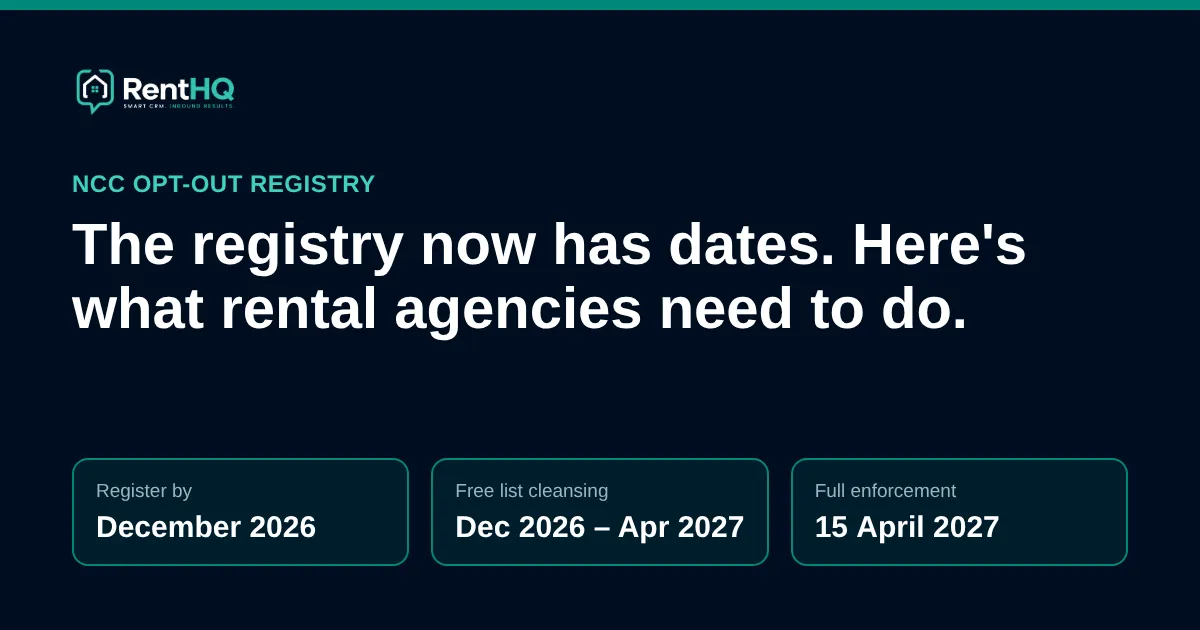
The Opt-Out Registry now has dates. Here's what rental agencies need to do.
For months, the question about the direct marketing rules has been "but when?" On 7 October, Minister Parks Tau answered it. At a media briefing on the National Opt-Out Registry, run by the National Consumer Commission (NCC), he set out the dates, the rules and the fines.
If your agency markets to landlords by email, SMS, phone or WhatsApp, this applies to you. Here's what was said, and what to do about it.
The three dates that matter
Registration: open now, until December 2026. Registration opened on 15 September. Every direct marketer must register, and then renew every year. The NCC hasn't confirmed the exact closing day yet, so don't plan around the last week of the year.
Cleansing: December 2026 to April 2027, free. For five months, the NCC will check marketers' lists against the registry at no cost. In the Minister's words, "the commission will carry the cost".
Full enforcement: 15 April 2027. From then, fines can go up to R1 million or 10% of annual turnover, whichever is greater.
What the Minister said marketers must do
Register before you market. "An unregistered marketer may not contact any consumer for direct marketing."
Cleanse every month. Check your list against the registry every month, before every campaign. This isn't a once-off clean-up.
Show who you are. Every message must carry your name, address and contact number. No hidden numbers.
A block beats old consent. If someone registers a block, it overrides consent they gave you before, including consent "buried in the fine print".
Your brand carries the risk. If others market for you, such as an agency or a call centre, make sure they're registered. "It is your brand that's on the line."
That last point matters more in a rental agency than almost anywhere else. Your agents prospect for landlords every day, and they do it under your agency's name.
Registering is only half of it: POPIA still applies
This was the most important point of the briefing, and it came from the Information Regulator, Adv. Pansy Tlakula.
Registering with the NCC doesn't make your marketing lawful on its own. It keeps you within the Consumer Protection Act. But if you contact someone who hasn't registered a block, you still need their consent under section 69 of POPIA, unless they're an existing client. And you may approach someone only once to ask for that consent.
The two regulators also split the complaints between them. The NCC handles general blocks on the registry. The Information Regulator handles everyone else.
So there are two separate questions to answer for every landlord on your list:
Has this landlord blocked direct marketing on the registry? That's the NCC's question, and monthly cleansing answers it.
Do we have this landlord's consent to market to them? That's POPIA's question, and only your own records can answer it.
A list that passes the first check can still fail the second.
What this means for a rental agency
Most agencies don't have one list. They have many: the newsletter list, an agent's spreadsheet of landlords she's been nurturing for years, a portfolio manager's contacts on his phone. Each one goes out under the agency's name.
Two things follow from the briefing:
Every one of those lists needs cleansing, every month. A list you can't see is a list you can't cleanse, and you can't show that it was cleansed.
Every landlord on them needs a consent trail. "They gave us their details at a show day in 2022" isn't the same as a record of consent.
The agencies best placed for 15 April 2027 won't be the ones with the biggest lists. They'll be the ones who know where every list is, and how every landlord on it got there.
What to do now
Register the business. Go to thencc.org.za and choose e-services. It takes a few minutes. Two tips from the NCC's own demonstration: register under your company's registered (CIPC) name, not your trading name, and use the email address of the person who will manage the account, because the login and notices go there.
Find every list. Ask your team what they've sent to landlords in the last three months, and from which list.
Check your consent. For each list, ask how those landlords got onto it, and whether you can show it.
Check what's on every message. Your agency's name, address and contact number belong on every newsletter, email and SMS.
Watch this space on WhatsApp. The NCC and Meta are still discussing how the registry applies to WhatsApp. There's no ruling yet.
Where RentHQ fits
We built RentHQ with FloServ Technologies for exactly this. It helps your agents build landlord lists the POPIA way: landlords ask for a free guide or an assessment and sign up themselves, and their consent is recorded at that moment.
It also makes the monthly cleanse something you can run for your whole team at once. Every agent's list sits in your agency's RentHQ account, so instead of chasing each agent's spreadsheet, you cleanse the whole team's lists in one go. Anyone who has registered a block is marked once, and nobody in your team can market to them from RentHQ again. Every agent keeps their own leads, and you know that nothing your team sends from RentHQ goes to an uncleansed list.
RentHQ doesn't register you with the NCC. That's yours to do, and step 13 above is the place to start. What RentHQ does is make sure the lists you're cleansing are ones landlords asked to be on, and that your whole team stays compliant together.
Want to see how RentHQ works?
Our Landlord Lead Machine page shows a month of landlord prospecting running on autopilot, in a live demo you can play. It walks you through the set-up step by step, and if you'd like the rest, a short sign-up sends you one email per step.
This article summarises the Minister's media briefing on the National Opt-Out Registry on 7 October 2026. It isn't legal advice. We'll update it as the NCC confirms the registration closing date and how cleansing will work.
